
Timber vs Concrete Fence Posts: Which Costs More and Is It Worth It?
Concrete fence posts cost more upfront, but the useful comparison is the cost of the complete support system rather than the price of one post. Using the same six-panel, 10m fence for both options, our timber post setup costs £165.34 before the fence panels are added. The equivalent concrete post and gravel board setup costs £329.57.
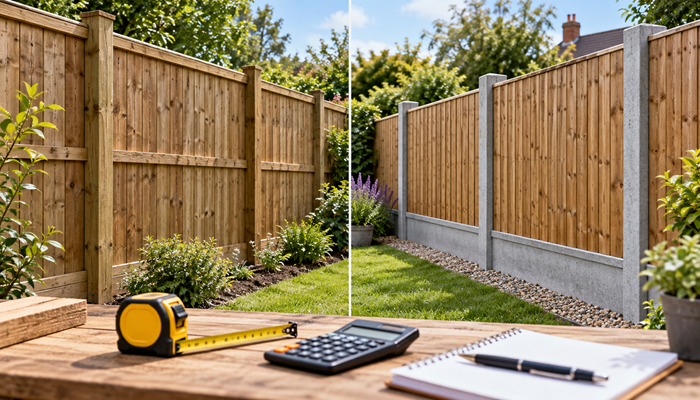
That makes concrete £164.23 more, or about £27.37 extra per fence bay, in our example. The question is whether the concrete system gives you something worth paying that extra money for. Prices were checked on 5 October 2026 and include VAT.
If you want to calculate the full cost of a fence rather than compare the post systems, use our garden fence cost calculator and 10m materials price comparison.
How Much More Do Concrete Fence Posts Cost?
For our like-for-like comparison, both systems use seven posts and 14 bags of post mix. The concrete version also needs six concrete gravel boards.
Timber support system: £165.34
- 7 x 2.4m 100mm x 100mm UC4 timber posts: £90.86
- 14 x 20kg bags of post mix: £74.48
Concrete support system: £329.57
- 5 x 2.4m concrete slotted posts: £107.65
- 2 x 2.4m concrete end posts: £59.00
- 6 x 1.83m concrete gravel boards: £88.44
- 14 x 20kg bags of post mix: £74.48
The difference is therefore not simply caused by swapping a £12.98 timber post for a £21.53 concrete post. In our example, the concrete posts themselves add £75.79. The gravel boards account for the remaining £88.44.
That is important if you are comparing wooden vs concrete fence posts from individual product prices. More than half of the extra cost in this example comes from another part of the concrete system.
What Does the Extra Cost of Concrete Actually Buy?
The biggest practical difference is what happens at ground level. Timber posts sit in or close to the ground and therefore need the correct treatment for that use. Concrete posts do not suffer from timber decay, while the gravel board also separates the bottom of the timber fence panel from the soil.
David Musson's concrete posts use slots designed for panel fencing, including Lap, Feather Edge and European-style panels. The panel and gravel board sit between the posts rather than relying on the same type of direct fixing used with a timber post.
That makes future panel replacement relatively straightforward: if a panel becomes damaged or worn, it can be removed from between the concrete posts without automatically replacing the posts as well.
The trade-off is weight and appearance. Concrete posts and gravel boards add a substantial amount of heavy material to the job and are visually more obvious than timber. David Musson's own installation guidance also describes the concrete system as requiring more precision and patience to install.
How Important Is UC4 Treatment for Timber Fence Posts?
If you choose timber, the treatment specification matters more than the colour of the treated wood or a vague description such as “pressure treated”.
The Wood Protection Association says timber used in permanent ground contact or providing exterior structural support should meet Use Class 4 (UC4). Its current guidance treats 15 years as the default desired service life unless a 30-year specification is requested. A desired service life is a treatment specification, not a guarantee that every post will last exactly that long.
The 100mm x 100mm timber post used in our comparison is sold as UC4 treated. David Musson states a desired service life of 15 years, while also making clear that this is not guaranteed and can vary with the environment.
The Wood Protection Association also advises allowing water to drain away from the foot of a post when a cement-based mix is used. You can read its UC4 guidance for fencing and landscaping timber for more detail.
Are Concrete Fence Posts Worth It?
They can be, but not for every fence. If your main priority is keeping the initial materials bill down, correctly specified UC4 timber posts are considerably cheaper in our comparison.
The case for concrete becomes stronger when avoiding timber at ground level matters more than the upfront saving. It may also be worth considering where replacing posts later would be difficult because of restricted access, established planting or landscaping around the fence line.
Concrete also makes sense if you specifically want gravel boards beneath the panels and value being able to replace panels independently of the posts. Those are tangible features of the system rather than an assumption that the more expensive option must automatically be better.
If appearance matters more and you prefer the fence supports to remain timber, the concrete premium may be difficult to justify. Timber is also easier to cut, drill and adapt when brackets, rails or other fittings need to be attached to the post.
One Important Exception: Slatted Fence Panels
Single and Double Slatted panels introduce another small cost when used with David Musson's concrete post and gravel board system. The panels are 1.8m wide, while the concrete system is designed around a 1.83m span.
David Musson recommends two panel packers per slatted panel to make up the difference. Six panels therefore need 12 packers, adding £29.40 at the prices used in our comparison.
For this specification, the concrete premium becomes £193.63, or about £32.27 per bay. It is a good example of why the final system price is more useful than comparing the headline price of the posts alone.
What If Only One Timber Fence Post Has Failed?
A failed timber post does not automatically mean the whole fence needs converting to concrete. If the rest of the fence is sound, repairing the individual post may be the cheaper route.
David Musson currently sells a 1.2m concrete repair spur for £19.49. It is designed to be fixed to a damaged timber post and set into the ground to strengthen the existing support.
Whether that is suitable depends on the condition of the post and the rest of the fence, but it is worth checking before pricing an entirely new run. Repairing one failed post and choosing a post system for a new fence are two different decisions.
Can We Compare the Lifetime Cost?
Not reliably from the evidence we have, so we have not produced a cost-per-year comparison.
We have a stated desired service-life specification for the UC4 timber post, but we do not have an equivalent guaranteed service life for the concrete posts that would allow a fair calculation. Ground conditions, installation and the individual product can also affect how long a fence support lasts.
Some fencing guides turn broad lifespan estimates into long-term cost claims. We think that would give these figures more certainty than the available evidence supports. The comparison on this page therefore sticks to the current upfront materials cost and the practical differences between the two systems.
Which Fence Post System Offers Better Value?
For a new Lap or Feather Edge fence where budget is the main concern, timber offers the lower upfront cost. In our example the saving is £27.37 per bay, provided the timber is correctly specified for ground-contact use.
Concrete asks you to spend more in return for a different type of system: no timber post at ground level, a concrete gravel board beneath each panel and slotted posts that make later panel replacement straightforward.
Neither makes sense in every situation. If future post replacement would be awkward, the concrete system may justify its higher starting price. If access is easy, you prefer the look of timber and initial cost matters most, paying extra for concrete may solve a problem you do not actually have.
Does Delivery Change Which Option Is Cheaper?
If both complete orders are being delivered to the same postcode, David Musson's delivery zone does not change the materials price difference between timber and concrete. The larger practical issue is handling: seven concrete posts and six concrete gravel boards make the concrete order much heavier if you are considering collection.
The final delivery charge should still be included when budgeting for the whole fence. Our garden fence cost calculator includes David Musson's current collection and delivery-zone charges.
Can a David Musson Voucher Reduce the Cost?
We have not deducted a voucher or promotion from the comparison because offers change and may include product, minimum-spend or other restrictions.
You can check our David Musson Fencing voucher codes and offers before ordering. Compare the terms with the products in your basket rather than assuming a discount will apply to the whole fencing order.
How We Compared Timber and Concrete Fence Posts
Prices were checked on 5 October 2026 and include VAT. The comparison uses the support materials for the same straight six-panel fence at approximately 6ft high.
The timber specification uses seven 2.4m 100mm x 100mm UC4 timber posts and 14 bags of 20kg post mix. The concrete specification uses five 2.4m slotted posts, two 2.4m end posts, six 1.83m x 150mm concrete gravel boards and the same 14 bags of post mix. Slatted panels require 12 additional packers when used with the concrete system.
This is a materials comparison rather than an installation quote. Labour, old-fence removal, access issues, ground conditions and other site-specific costs are excluded. Product prices can change, so check the current merchant prices before ordering.
Written by Julian House on 6th October 2026

Enter to Win 1 of 6 × £50 Greggs Gift Cards
Complete the form below to enter. One entry per person. No purchase necessary.
Advertisement
Advertisement
Charity Donation
Thank You!
You've Helped Us Raise
£0.00
For Charities Since 2012
This Weeks Most Popular Blog Articles
Concrete fence posts cost more upfront, but the useful comparison is the cost of the complete...
Searching only for a DFDS voucher code can now mean missing other ways to reduce the fare. We...
A 10-metre garden fence can cost from £377.32 in materials using Green Lap panels and timber posts...
*/
Halloween has a habit of getting expensive without ever feeling especially expensive. A bag of...
Free Uber Eats can mean several different things. You might get a meal covered by referral credit,...
This Month's Charity
Brook Farm Animal Sanctuary
£179.34 Donated This Month
Total Raised for Charities Since 2012: £88,475.84
Thanks to our loyal users, we’re supporting RSVP Charity. Keep using our voucher codes to help us give even more.