
What Is the Cheapest Car to Insure in the UK?
There is no single car that will be the cheapest to insure for every UK driver. Recent policy-sales data puts the Mazda MX-5 at the top of the overall table, with a median annual premium of £263, while the Skoda Citigo was cheapest among drivers aged under 25 at £544. Look only at current new-car insurance groups and the answer changes again: the Hyundai i10 1.0 automatic sits in group 1. These figures measure different things, so none of them guarantees the price you will personally receive. Your age, address, driving history, mileage and the exact vehicle specification will still affect the result. Before paying a deposit on any car, compare quotes using its registration or full derivative on our cheapest car insurance page. Source: Which? Source: RAC
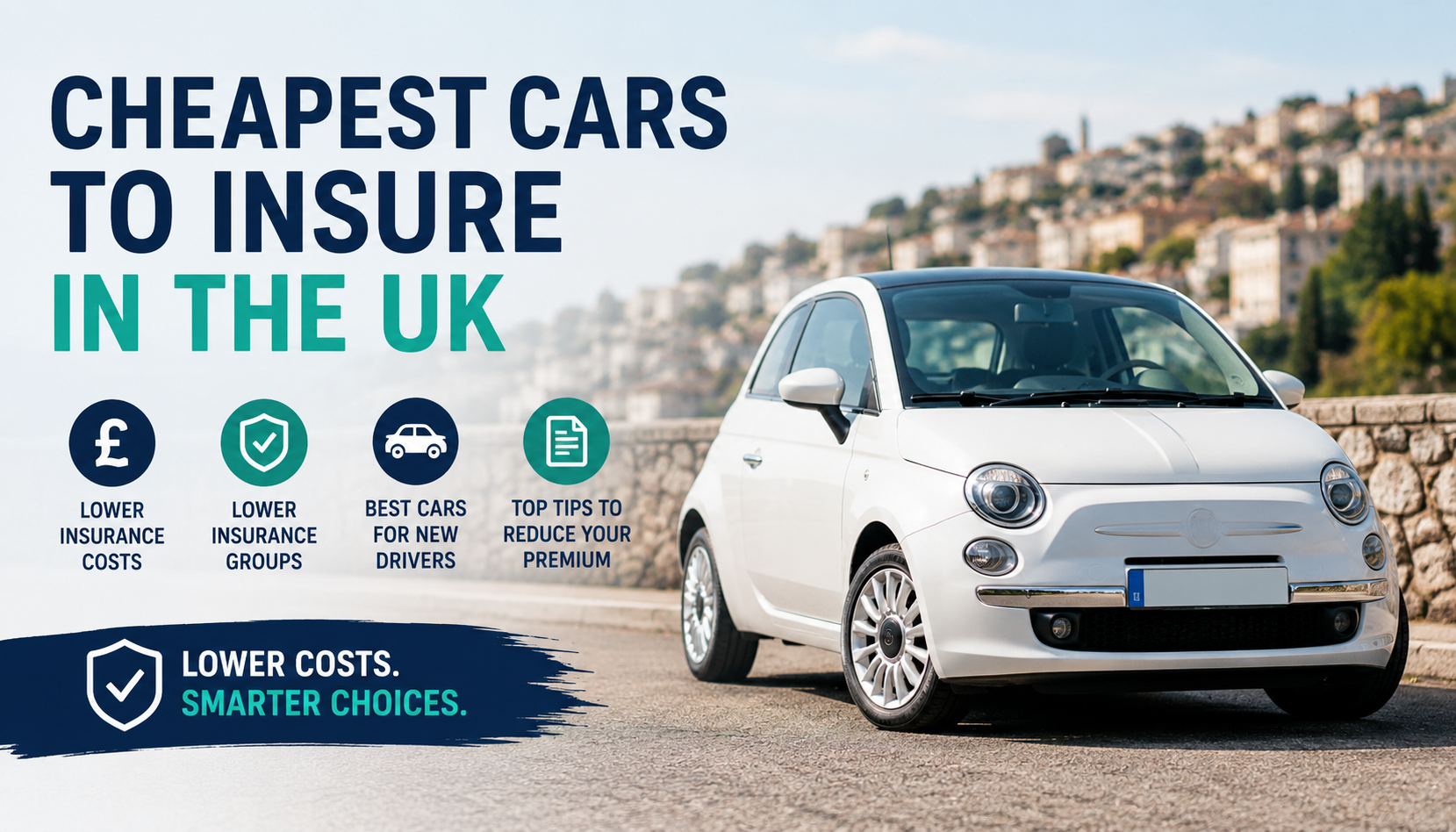
Three different answers to the cheapest-car question
“Cheapest to insure” sounds straightforward until you look at how the answer was calculated. A car may have a low published insurance group but still produce a higher quote for a particular driver. Equally, a model with a higher group can appear near the top of real policy-sales data because it is commonly owned by experienced, lower-risk motorists.
| Question being answered | Current result | Evidence used | Important limitation |
|---|---|---|---|
| Which model had the lowest median premium overall? | Mazda MX-5, £263 | Go.Compare policy sales from 1 April 2025 to 31 March 2026 | The result reflects the people who bought cover for that model, not the price every driver will receive. |
| Which model was cheapest for drivers under 25? | Skoda Citigo, £544 | Go.Compare policy sales to drivers aged under 25 from 1 April 2025 to 31 March 2026 | It is a median across sold policies and not a quote guarantee. |
| Which current new car has the lowest published group? | Hyundai i10 1.0 automatic, group 1 | RAC's January 2026 new-car insurance-group shortlist | Only the specified engine and gearbox sit in group 1. |
The Go.Compare figures reported by Which? cover annual-payment policies, cars manufactured from 2016 onwards and models with at least 100 sales. That methodology makes the data useful, but it does not turn the listed premium into a price available to everybody. Source: Which?
Which cars had the lowest median insurance premiums in 2026?
In the overall Go.Compare sales data, the Mazda MX-5 was followed by the Fiat Panda and Fiat 500C. The list is unusual because it mixes city cars with two-seat sports cars. That is a useful warning against judging insurance cost from a car’s appearance or performance alone.
| Rank | Car | Median annual premium | What the result tells us |
|---|---|---|---|
| 1 | Mazda MX-5 | £263 | The drivers buying these policies may have a relatively favourable risk profile. |
| 2 | Fiat Panda | £268 | A compact, modestly powered car can still perform well in real policy data. |
| 3 | Fiat 500C | £273 | The convertible version appeared ahead of many conventional small hatchbacks. |
| 4 | Smart Fortwo | £282 | Its compact size and typical usage may contribute to the recorded result. |
| 5 | Skoda Citigo | £288 | It also performed strongly in the separate under-25 table. |
| 6 | Suzuki Celerio | £298 | A straightforward city car with relatively modest performance. |
| 7 | Suzuki Jimny | £298 | A small four-wheel drive can produce a different result from what its shape suggests. |
| 8 | Mercedes-Benz SLC | £301 | Owner profile can matter as much as the badge or body style. |
| 9 | Renault Twingo | £301 | Another compact car appearing among the lower recorded medians. |
| 10 | Dacia Logan | £304 | A practical model that may appeal to drivers with a different risk profile from younger city-car owners. |
These were median premiums on policies actually sold, rather than sample quotes created for one fictional driver. Even so, the table should not be read as a shopping ranking. A newly qualified driver trying to insure an MX-5 could receive a very different result from the median above. Source: Which?
Cheapest cars to insure for drivers under 25
The under-25 results look rather more familiar. Small city cars dominate, with the Skoda Citigo recording the lowest median premium in the dataset. It was followed by the Peugeot 108, Fiat 500, Citroën C1 and Volkswagen Up.
| Rank | Car | Median annual premium for under-25s |
|---|---|---|
| 1 | Skoda Citigo | £544 |
| 2 | Peugeot 108 | £561 |
| 3 | Fiat 500 | £567 |
| 4 | Citroën C1 | £571 |
| 5 | Volkswagen Up | £574 |
| 6 | Kia Picanto | £579 |
| 7 | Vauxhall Adam | £587 |
| 8 | Mini One | £596 |
| 9 | Vauxhall Viva | £596 |
| 10 | Hyundai i10 | £597 |
Again, those figures are medians from sold annual policies, not prices promised to the next person who applies. They do show why the Citigo, 108, C1 and Up remain worth checking on the used market, even though several are no longer available as brand-new cars. Before travelling to view one, get its registration number and quote that particular vehicle. Source: Which?
The lowest-group new cars are not all alike
For somebody buying new, insurance groups remain a practical way to create a shortlist. RAC’s January 2026 assessment places the Hyundai i10 1.0 automatic in group 1, followed by the Volkswagen Polo 1.0 Life in group 3. The Skoda Fabia 1.0 MPI and Kia Picanto 1.0 DPi 2 sit in group 4, while the Toyota Aygo X 1.0 Pure is in group 5.
The headline group does not tell you whether the car will suit your driving. The group 1 Hyundai uses a 63hp 1.0-litre engine with a five-speed automated manual gearbox. RAC found that gearbox less smooth than the conventional manual, which sits in group 2. A one-group increase may be worth testing if the manual is easier to live with.
The Polo offers a more settled choice for regular motorway use, but only the specified entry-level engine and Life trim produce the quoted group 3 result. The Fabia gives you more cabin and luggage space than many city cars. For drivers mainly covering short urban journeys, the Picanto, i10 and Aygo X may be easier to park, although rear-seat and boot requirements still need checking.
Buying the lowest-group version is not automatically economical if it costs considerably more to purchase, is difficult to find used or does not suit the journeys you make. Insurance is only one part of the car’s running cost. Source: RAC Source: MoneyHelper
Why insurance groups and real premiums give different winners
Thatcham Research describes Group Rating as an advisory measure used by insurers to help quantify vehicle risk. The current scale runs from 1 to 50 and assesses more than 125 vehicle attributes. These include parts prices and the standard fitment and performance of autonomous emergency braking systems. The rating is therefore about the vehicle, not the complete person-and-car combination presented to an insurer.
Thatcham is moving towards Vehicle Risk Rating, a five-part assessment covering damage, repair, safety, security and performance. That gives insurers more detailed information about modern vehicles, but it still does not dictate the final premium.
Actual policy-sales data answers a different question. It shows what a group of real customers paid after their age, address, driving history, mileage, occupation, use and other details were considered. This helps explain how the Mazda MX-5 and Mercedes-Benz SLC appeared in the overall low-premium table while small city cars dominated the under-25 results. Source: Thatcham Research Group Rating Source: Thatcham Research Vehicle Risk Rating
Is a new or used car cheaper to insure?
Neither is automatically cheaper. A used city car may cost less to replace and could sit in a low insurance group. It might also have older security equipment, a claims pattern insurers dislike or modifications fitted by a previous owner.
A new car can include stronger safety and security technology, but its higher replacement value and repair costs may work against it. Even two used cars with the same model name can produce different prices because the engines, trim levels and production years are not identical.
Ask the seller for the registration number. That is more useful than searching for a broad claim such as “Fiat 500 insurance cost”, because a quote can then identify the actual derivative. Also check the total buying and running cost. Saving a modest amount on insurance would not justify paying thousands more for a car that otherwise fails to meet your budget or needs. Source: MoneyHelper
Why the result changes from one driver to another
A newly qualified driver may find that the precise engine and trim make a substantial difference. An experienced motorist with a long no-claims history could receive competitive prices on a car that looks surprising in an overall table. Low-mileage drivers may be offered different options again, including policies that measure mileage or driving behaviour.
Location matters too. Insurers consider factors such as local claims and theft experience, while commuting or business use changes how the vehicle is used. Adding another driver can alter a quote, but the main driver must always be declared accurately. A parent should not be listed as the main driver when their son or daughter is actually the principal user.
This is why two people can quote for the same registration number and receive very different results. The car has not changed. The risk information around it has. Source: MoneyHelper
Get a quote before paying for the car
Insurance should be checked while you are comparing cars, not after a deposit has been paid. Use the same accurate driver details for each vehicle so the results are reasonably comparable.
- Choose two or three cars that meet your budget, space and driving requirements.
- Record the registration number or complete engine, trim and gearbox description.
- Use the same address, mileage, occupation, cover and named-driver details for every quote.
- Compare the total annual price, monthly repayment total, compulsory excess and voluntary excess.
- Check whether breakdown cover, legal cover, a courtesy car or other extras are included or charged separately.
Before buying, compare the exact vehicle using the registration number where possible. Our cheapest car insurance page introduces Quotezone’s comparison service, where you can view available quotes using your own car and driver details.
Using the comparison page can also support our wider charity work. My Favourite Voucher Codes donates 20% of its profits to charity through a monthly public poll, at no extra cost to the user. You can find further information on our About Us page.
Could you lower the premium without choosing another car?
Possibly, although no individual step will reduce every quote. Start with an accurate mileage estimate. Paying for more miles than you are likely to drive may be unnecessary, while giving an unrealistically low figure can create problems if the information is wrong.
Check annual and monthly payment totals separately. MoneyHelper notes that insurers sometimes charge interest when the premium is paid by instalments, so annual payment can cost less overall when it is affordable. A higher voluntary excess may reduce the quoted premium, but you must be able to pay that amount as well as the compulsory excess if you claim.
Do not assume third-party cover will be cheaper. MoneyHelper states that it can cost more than policies offering wider protection, depending on the driver and circumstances. Compare suitable levels of cover rather than removing protection simply to chase the opening price.
Telematics may be worth checking for an inexperienced driver, but read the conditions. Some policies monitor when, where or how the car is driven. Finally, declare alloy wheels, performance changes and other modifications accurately. Incorrect information can affect whether a future claim is paid. Source: MoneyHelper
Car insurance checklist before you buy
- Confirm the registration number and exact derivative.
- Check the engine, gearbox and trim rather than relying on the model name.
- Declare any factory options or later modifications.
- Use a realistic annual mileage estimate.
- Select the correct social, commuting or business use.
- Compare annual cost with the full cost of monthly instalments.
- Add compulsory and voluntary excesses together.
- Check cover for windscreens, keys, personal belongings and a courtesy car.
- Read significant exclusions before choosing a policy.
- Run the quote before paying a deposit on the vehicle.
Which car is likely to cost you least to insure?
Based on current sold-policy data, the Mazda MX-5 had the lowest overall median premium, while the Skoda Citigo came first for drivers under 25. For a current new car with the lowest published group, the Hyundai i10 1.0 automatic is the clearest answer.
None is a guaranteed winner for an individual driver. Use those results to build a shortlist, then quote the exact registration and compare the cover, excess and total price. That gives you a more useful answer than choosing a car from its insurance group alone. Source: Which? Source: RAC
Frequently asked questions
What is the cheapest new car to insure in the UK?
The Hyundai i10 1.0 automatic is currently one of the clearest answers based on new-car insurance groups because the specified 63hp version with the automated manual gearbox sits in group 1. That rating does not guarantee the lowest personal quote. Source: RAC
What is the cheapest car to insure for drivers under 25?
The Skoda Citigo had the lowest median annual premium in Go.Compare data for policies sold to drivers under 25 between 1 April 2025 and 31 March 2026. Its recorded median was £544, but personal quotes will vary. Source: Which?
Are automatic cars more expensive to insure?
Not always. Insurance depends on the exact derivative and wider driver details. The Hyundai i10 provides a useful exception because its 1.0-litre automated manual version sits in group 1, while the conventional manual is listed in group 2. Source: RAC
Can a sports car ever be cheaper to insure than a small hatchback?
Yes, in aggregated policy data. The Mazda MX-5 recorded the lowest overall median premium in the 2026 Go.Compare analysis. This does not mean it will be inexpensive for every driver, particularly a young or inexperienced motorist. Source: Which?
Does a group 1 car guarantee cheaper car insurance?
No. Group 1 indicates low vehicle risk within the advisory rating system, but insurers also consider the driver, address, mileage, use, claims history and other information before calculating a premium. Source: Thatcham Research
Is comprehensive insurance always more expensive than third party?
No. MoneyHelper states that third-party cover can be more expensive than policies providing wider cover. Compare suitable cover levels and check what is included rather than assuming the policy with the least protection will cost less. Source: MoneyHelper
Do car insurance groups ever change?
Vehicle-risk information can be updated as technologies and assessment methods change. Thatcham Research is moving from the traditional Group Rating system towards Vehicle Risk Rating, which assesses damage, repair, safety, security and performance. Source: Thatcham Research
Should I get an insurance quote before buying a used car?
Yes. Ask for the registration number and quote the actual vehicle before paying a deposit. This identifies the precise derivative and gives a more useful indication than relying on a general list of models or insurance groups.
Witten by Julian House on 15th June 2025


Enter to Win 1 of 6 × £50 Greggs Gift Cards
Complete the form below to enter. One entry per person. No purchase necessary.
Advertisement
Advertisement
Charity Donation
Thank You!
You've Helped Us Raise
£0.00
For Charities Since 2012
This Weeks Most Popular Blog Articles
Lookfantastic has released four quite different Advent calendars for Christmas 2026. There is a...
The Ninja SLUSHi Twist makes an impressive first impression: two frozen drinks, two flavours and...
If both Stena Line and Irish Ferries work for the journey you are planning, the discounts can make...
The best time to book Stena Line is usually once your travel dates are reasonably firm, rather than...
Wedding planning often involves comparing prices, working out where to save and deciding which...
This Month's Charity
Brook Farm Animal Sanctuary
£179.34 Donated This Month
Total Raised for Charities Since 2012: £88,475.84
Thanks to our loyal users, we’re supporting RSVP Charity. Keep using our voucher codes to help us give even more.