
Blackjack basic strategy rests on the maths of each hand
Blackjack charts can look more authoritative than they really are. Rows, columns and short instructions give the impression of a fixed answer to every situation, but the chart is only the visible output of a probability model. Change the assumptions behind that model and some of its conclusions can change as well.
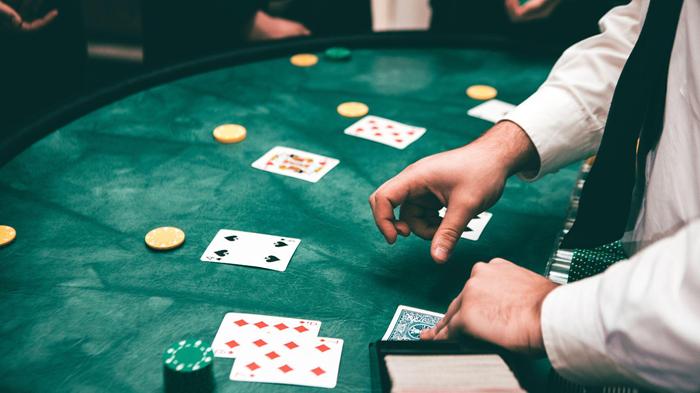
At the centre is expected value: a mathematical way of combining possible outcomes with the probability of each occurring. It describes a long-run average across repeated comparable situations, not what will happen on the next hand. That means a theoretically calculated result can differ sharply from what happens during a short session.
As a casino-game category, blackjack is unusual because the game permits decisions within its published rules, but those choices do not remove the underlying house advantage or turn the game into a predictable source of income.
A mathematical model depends on assumptions
No probability model exists independently of the rules used to build it.
The calculation needs to know how many decks are in play, what the dealer must do on a soft 17, how a natural blackjack is paid, whether surrender is available and what restrictions apply to doubling or splitting. Change one of those conditions and the probability tree changes with it.
That does not mean every rule variation produces a dramatically different result. Many calculated relationships remain similar. Close comparisons, however, can move when the underlying assumptions change.
For remote games offered to consumers in Great Britain, the Gambling Commission’s RTS 3 on game rules and the likelihood of winning requires relevant information to be available before a customer commits to gamble. Its guidance identifies details such as the number of decks or frequency of shuffles in virtual card games, alongside information such as house edge, RTP or the probability of winning.
That information is more than fine print. It defines some of the assumptions under which a mathematical description of the game has meaning.
Expected value is an average, not a forecast
The phrase “expected value” is easily misunderstood because “expected” sounds like a prediction.
The University of California, Berkeley’s explanation of expected value defines it as a weighted average of the possible values of a random variable, with each value weighted by its probability.
Applied to blackjack, that distinction is important. A mathematical model can compare the long-run consequences associated with different branches of the game without knowing what card will appear next.
The calculated average can be negative even when individual hands produce wins. Conversely, a decision with a less negative theoretical expectation can still produce repeated losses over a short run. Neither result contradicts the probability calculation.
Betting systems and loss-recovery progressions do not change that relationship. Increasing a stake after a loss changes the amount of money exposed; it does not alter the underlying probabilities of the next round.
Why rules can produce different results
Two published models may appear to describe the same game while relying on different assumptions.
One may use a different number of decks. Another may assume a different dealer rule for soft 17. Payouts, shuffle procedures or the availability of certain actions can also change the calculation.
Methodology can create further differences. Models may use exact combinatorial calculations or computer simulations, while published versions sometimes simplify borderline cases. A disagreement is therefore not necessarily evidence that one approach has found a superior system. The first question is whether both calculations describe the same rules.
This is also why a house-edge or RTP figure should not be separated from its assumptions. A percentage calculated for one ruleset does not automatically describe another game carrying the same blackjack label.
RTS 3C reinforces that point. For a game containing an element of skill, the Gambling Commission says theoretical RTP should be calculated using either the auto-play strategy or a standard or published strategy. The published percentage can therefore depend on the decision assumptions built into the calculation, rather than existing independently of them.
Mathematical precision does not remove uncertainty
Blackjack has a defined probability structure, but that should not be confused with certainty.
The player does not know the next card, while the dealer’s eventual hand is also unknown. Mathematics distributes probabilities across those possible outcomes; it cannot identify which branch will occur in an individual round.
Even a very small difference between two theoretical averages says nothing about the order in which wins and losses will appear. Short sequences can sit far away from long-run averages.
This uncertainty also matters from a responsible-gambling perspective. A lower theoretical house advantage does not make losses impossible or provide a reliable route to income. Money used for gambling remains exposed to loss, irrespective of how precisely the underlying probabilities have been calculated.
The model should therefore be read as a description of long-run relationships under specified conditions, not as a forecasting tool. It cannot identify when a win is “due”, predict streaks or make larger wagers safer after previous losses.
The rules are the starting point
For remote games offered to consumers in Great Britain, regulatory information about the rules and likelihood of winning provides a more reliable starting point than assuming that a generic mathematical model applies everywhere.
Deck count, dealer rules, payouts, shuffle procedures and available actions all feed into theoretical return. They establish the mathematical environment before a chart or percentage is produced.
None of those calculations turns blackjack into an investment or a method of generating dependable income. Expected value describes what a probability model implies over repeated comparable events; it does not guarantee the result of a hand or session.
In Great Britain, the minimum legal age for casinos and online gambling is generally 18. Anyone concerned about their gambling, or someone else’s, can contact the National Gambling Helpline, which the Gambling Commission lists as a free, 24-hour source of support.
A blackjack chart is ultimately a compressed representation of a mathematical model. Its conclusions belong to the rules and assumptions from which it was calculated, while its long-run averages should never be mistaken for predictions about what happens next.

Enter to Win 1 of 5 × £250 Amazon Vouchers
Complete the form below to enter. One entry per person. No purchase necessary.
Advertisement
Advertisement
Charity Donation
Thank You!
You've Helped Us Raise
£0.00
For Charities Since 2012
This Weeks Most Popular Blog Articles
Most football bettors know how to read odds as returns. If an EPL team has 1.50 odds of winning, a...
Blackjack charts can look more authoritative than they really are. Rows, columns and short...
There are few better times to tackle that growing list of household jobs than when the Black Friday...
If you're thinking about straightening your teeth, you've probably come across Invisalign. It's one...
If you're thinking about having your teeth whitened professionally, one of the first things you'll...
This Month's Charity
Brook Farm Animal Sanctuary
£182.39 Donated This Month
Total Raised for Charities Since 2012: £88,801.00
Thanks to our loyal users, we’re supporting Ray of Light Wales Charity. Keep using our voucher codes to help us give even more.